The maker movement creates opportunities for students to engage in hands-on learning experiences, fostering their creativity alongside higher-order and computational thinking skills (Bower, et al., 2018). Classrooms which provide students with opportunities to design and make, develops student’s problem-solving skills. The ‘learning by doing’ approach to learning supports Jean Piaget’s constructivism. Schools can implement constructivism by implementing maker spaces, which can be a physical space or a set of materials that encourages students to learn by doing. Over the recent years, there has been a larger push towards STEM learning in the primary school. STEM learning can include robotics, coding and science experiments. However, maker space-based activities can be implemented across various KLAs and year levels (Martienz & Stager, 20014).
An example of maker spaces in the primary classroom is the Makey Makey. The Makey Makey is a USB device which can turn almost anything into a computer input. The only requirement is a material which can conduct electricity attached with alligator clips to the circuit board.
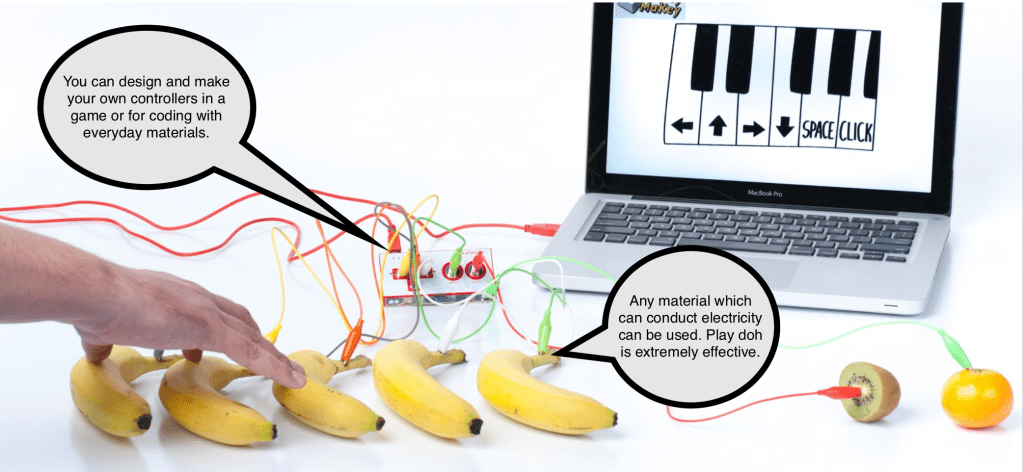
How can Makey Makey be used in the classroom?
• Makey Makey can be used in conjunction with educational coding programs such as Scratch.
• In Science, students can test how to conduct electricity or create a path to conduct electricity.
• In Music, students can use Makey Makey as a piano, experimenting with different materials to be used as the keys.
Makey Makey fosters creativity through creating innovative solutions, promotes experimentation with materials and ideas and provides opportunities to design and create. Makerpsaces provides students with authentic, hands-on learning experiences which encourages meaningful knowledge creation.
Key considerations:
Maker spaces and Makey Makey can seem daunting to teachers and educators. It is essential teachers are provided with professional learning and resources to effectively implement maker spaces into their classrooms and build their confidence in using new technologies (Bower et al., 2018).
References:
Bower, M., Stevenson, M., Falloon, G., Forbes, A., & Hatzigianni, M. (2018). Makerspaces in primary school settings: advancing 21st century and STEM capabilities using 3D design and printing. Available at http://primarymakers.com
Martinez, S., & Stager, G. (2014). The maker movement: A learning revolution. Learning & Leading with Technology.

